Why Wanting Something Can Feel Like Progress Right Until Reality Asks for Evidence

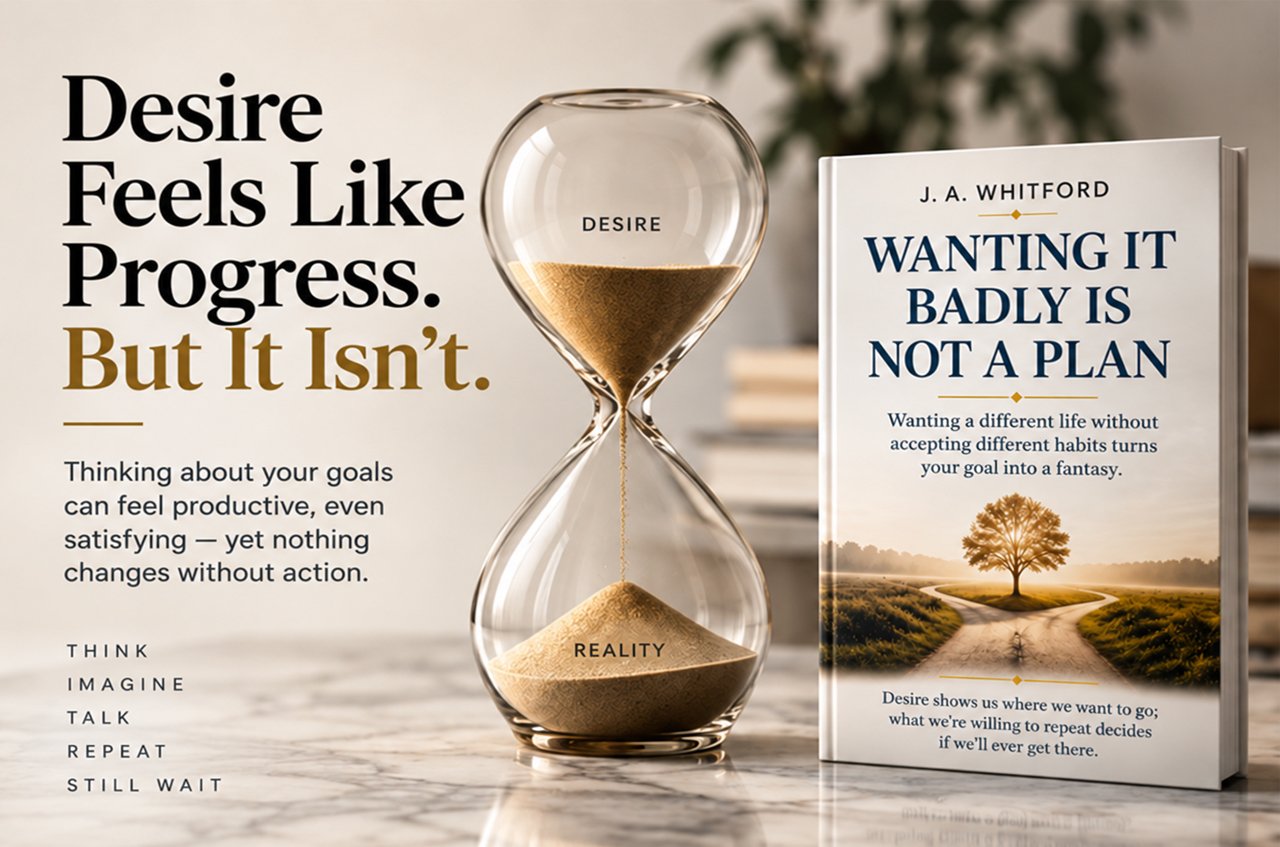

“Wanting a different life without accepting different behaviors is an elegant way to turn a goal into a fantasy.”
We are taught to want intensely, visualize in detail, ask with conviction, and keep the faith as if the universe were standing nearby with a notebook taking orders. Wanting something can feel surprisingly productive: we think about it, talk about it, imagine what having it would feel like, and may even experience a few minutes of relief. The problem begins when we mistake that mental activity for actual movement.
Scarcity has a particular talent for capturing attention. The more strongly we feel that something is missing, the more space it occupies in the mind. Money, recognition, time, opportunity, relationships, or freedom can become objects of constant surveillance. And without noticing it, we begin spending more energy watching what we do not have than building the conditions capable of producing it.
This book reveals the difference between wanting an outcome and creating the architecture that makes it more likely. Imagining can provide an immediate reward; building requires repetition, delay, uncomfortable decisions, and behaviors that may receive no applause for quite some time. It is like spending hours admiring a photograph of a house and then being surprised when you look outside and the lot is still empty.
This is where the useful part begins. Readers learn to separate intention from execution, recognize when a goal still exists mainly in imagination, and convert abstract desires into observable conditions: habits, environments, decisions, sequences, and repetitions. The question stops being only, “How badly do I want this?” and becomes, “What am I doing today that makes this more likely to happen?”
This is where the useful part begins. Readers learn to separate intention from execution, recognize when a goal still exists mainly in imagination, and convert abstract desires into observable conditions: habits, environments, decisions, sequences, and repetitions. The question stops being only, “How badly do I want this?” and becomes, “What am I doing today that makes this more likely to happen?”
The book also shows how to use the experience of lack without allowing it to become an identity. What is missing can serve as information rather than a verdict. Instead of treating the distance between the current life and the desired one as proof of inadequacy, it can become a map: what must be built, what must be repeated, what environment must change, and what behavior can no longer remain negotiable.
We live surrounded by messages promising results if we think correctly, want intensely enough, or visualize with the proper emotion. Thinking helps. Desire gives direction. Visualization can create clarity. But none of them lays the bricks. The purpose of this book is to turn desire into structure, structure into repetition, and repetition into a reality that no longer needs to be imagined because it can finally be inhabited.
“Desire points to the destination; what you repeat determines whether what you desire ever becomes reality.”