How Convenience Expands What We Can Do — While Slowly Changing What We Can Still Do Without It

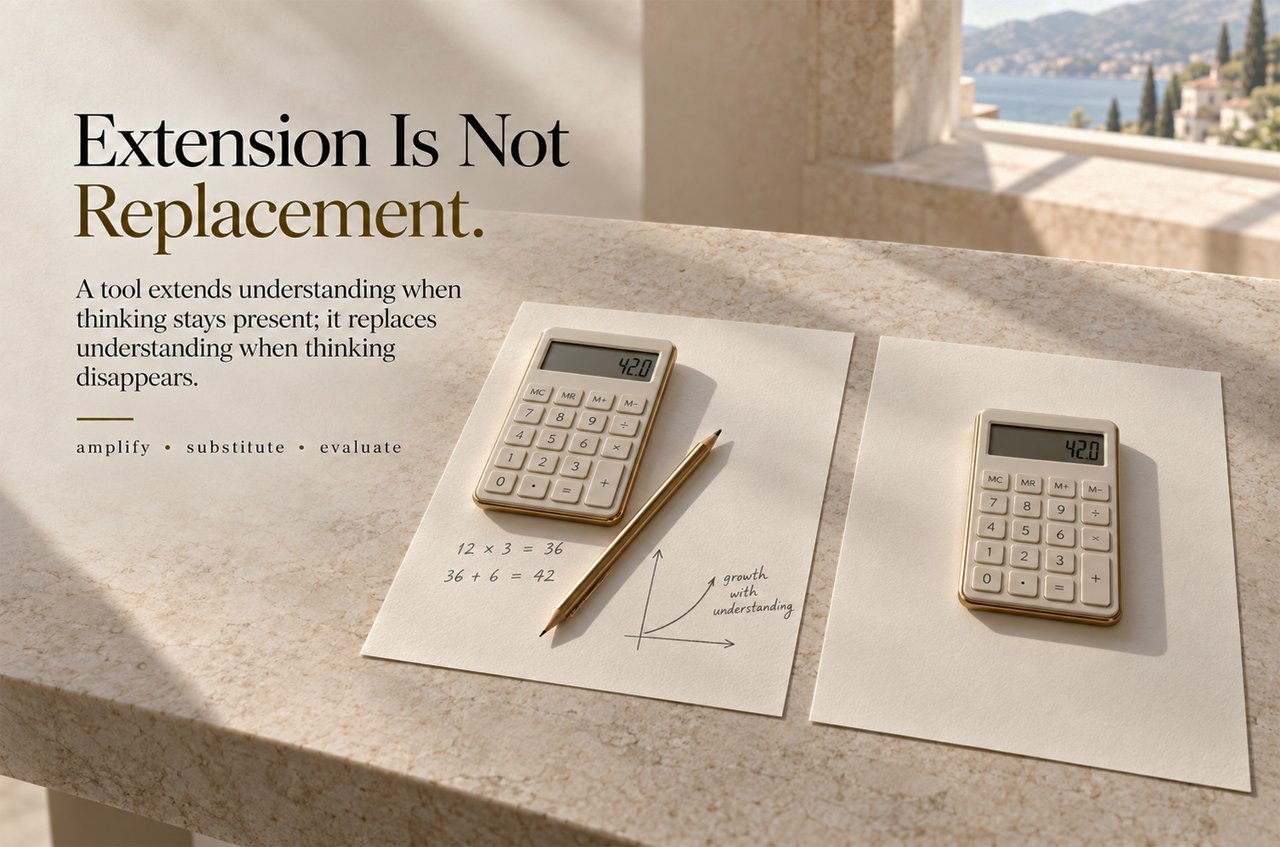

“ Every tool that removes effort gives us time; the uncomfortable question is what ability that effort was training.”
Technology is not the problem. In fact, it is one of the most extraordinary expressions of human intelligence. Over thousands of years, we developed abilities to remember, calculate, navigate, organize information, communicate, compare alternatives, and solve problems; then we built tools capable of extending those same functions and integrated them into our lives in increasingly natural, pleasant, and desirable ways. That process can dramatically expand what human beings are capable of doing. The problem begins when we confuse amplifying a capability with no longer needing to possess it.
Progress removes difficulty, and that is precisely part of what progress is supposed to do. We no longer need to memorize every number, navigate without GPS, perform every calculation mentally, spend hours locating information, or personally complete repetitive tasks that a machine can perform faster and more accurately. But some of those activities did more than produce an outcome. They also trained attention, memory, orientation, reasoning, patience, comparison, tolerance for error, and autonomy. When we eliminate the task, we may accidentally eliminate part of the training embedded inside it.
The fundamental distinction is between amplification and substitution. A calculator amplifies someone who understands the calculation; it can substitute for understanding in someone who never learned what is being calculated. GPS amplifies mobility; it can weaken orientation when we stop constructing mental maps. Artificial intelligence can expand thought, analysis, and creativity when it works with an active mind; used to avoid thinking, it can generate extraordinary answers while the person receiving them gradually loses the ability to evaluate them. The problem is not that the tool becomes too capable. It is that it becomes so good that we stop noticing what we no longer practice.
Evidence of this substitution is everywhere. We stopped memorizing numbers because our phones remember them; then we exercised less of the associative memory once used to connect names, sequences, and contexts. We stopped navigating because GPS knows the route; then we began requiring turn-by-turn instructions even in familiar places. We stopped calculating because an application provides the answer; then it became harder to recognize when the answer simply makes no sense. We stopped writing in order to organize ideas because a tool can draft them; then we forgot that precise formulation was itself part of learning how to think. We allow algorithms to determine what we read, watch, and hear; then repeated exposure begins to feel suspiciously similar to personal preference. And now artificial intelligence can research, compare, summarize, argue, and produce for us. The question is no longer whether it can. The question is how much of what it produces we will still be capable of evaluating when it is no longer obvious how the answer was constructed.
The cost of losing one capability rarely ends with that single capability. Spatial orientation contributes to mental mapping; writing forces us to organize sequences, relationships, and hierarchies; calculation builds numerical intuition; remembering requires attention; comparing arguments strengthens judgment; remaining with an unanswered question trains tolerance for uncertainty. Human abilities operate in networks. When one is no longer exercised, we may also reduce some of the training that supported abilities we still consider indispensable. This creates a remarkably modern contradiction: we celebrate the fact that a tool saves us from thinking about something without asking what other forms of thought were being trained while we did it.
What makes the process especially dangerous is that the loss feels good. It arrives wrapped in convenience, speed, precision, elegant design, and efficiency. No one longs to be lost for forty minutes when GPS can provide a route in three seconds. No one wants to perform unnecessary calculations when a machine can solve them instantly. No one wants to return to spending hours finding information that now appears in seconds. Progress does not need to move backward. But precisely because substitution feels so comfortable, we can surrender capabilities gradually while feeling more advanced as we become less autonomous.
That is where the romanticization of decline begins. Modern decline rarely arrives looking deteriorated. It usually arrives updated, synchronized, beautifully designed, and with an extraordinary user experience. Loss stops looking like loss because it is accompanied by the sensation of progress. Every new delegation appears small, logical, and efficient; the deterioration becomes visible only when we discover that the tool that once assisted us has become necessary for performing something we once knew how to do without it.
This exchange matters even more because many of the abilities we are beginning to exercise less are precisely the abilities that will become more valuable in a future that has already arrived. When producing text becomes cheap, judging it becomes more valuable. When answers are instantaneous, asking good questions matters more. When a machine can generate a hundred alternatives in seconds, choosing among them becomes more important. When information becomes effectively infinite, judgment, sustained attention, deep understanding, creativity, intellectual autonomy, and the ability to detect error will no longer be complementary skills. They will become part of the human advantage.
Becoming less capable also creates dependency. The less we can do without a tool, the more indispensable that tool becomes; the more indispensable it becomes, the more functions we are willing to surrender; and the more we surrender, the less daily incentive remains to preserve the original capabilities. The loop begins feeding itself: we depend on the tool because we stopped practicing the function, and we stop practicing the function because we already depend on the tool. Convenience can therefore become an architecture of dependency while we continue celebrating each new layer of automation.
There is an additional difficulty: recovering a lost capability is harder than preserving one. Many human abilities developed because everyday life forced us to practice them hundreds or thousands of times without anyone calling it training. Navigating, remembering, calculating, observing, waiting, comparing, writing, solving. When technology removes that daily exposure, it also removes part of the cognitive gym that kept those functions active. We may decide to recover an ability, but now we must deliberately recreate the conditions of practice that the environment once provided automatically. The tool did not merely make the task easier; in some cases, it removed the environment in which we learned how to perform it.
The book therefore establishes a practical principle: delegate load without delegating capability. Automate repetition while preserving understanding. Use assistants without surrendering judgment. Benefit from navigation without abandoning orientation. Externalize working memory without giving up internal knowledge. Allow artificial intelligence to accelerate analysis, creation, research, and production while preserving the human responsibility to question, compare, interpret, and decide. Real progress occurs when a tool enables something we could not previously do—not merely when it makes unnecessary something we should still know how to do.
Technology will continue advancing, and it should. The relevant question is no longer how much it can do for us, but what we still want to remain capable of doing while it thinks, remembers, navigates, writes, and decides beside us. A technologically advanced society does not need humans competing with their tools. It needs humans developed enough to direct them. The objective is not to preserve difficulty out of nostalgia. It is to preserve the capabilities that allow us to enjoy convenience without gradually becoming dependent on it.
“ Perhaps the greatest technological luxury of the future will not be owning a tool capable of doing everything for you, but remaining a person capable of deciding what should never be surrendered to it.”