How the Attention Economy Turned Curiosity Into a Full-Time Disappearance Act


“Your phone does not always steal your time; sometimes it does something better: it gets you to hand it over voluntarily.”
You open your phone to answer a message and, twenty minutes later, you are watching a stranger restore a table you will never buy. There was no kidnapping, threat, or physical force involved. You entered willingly. The uncomfortable detail is that you have forgotten why you went in. That small episode seems trivial until it happens several dozen times a day.
This book reveals what happens when curiosity, novelty, variable reward, and almost frictionless access compete for an attention system with limited capacity.
Platforms do not need to force you to stay; they only need to make the next thing seem slightly more interesting than the last. It is like walking into a supermarket for milk and discovering three hours later that you are still inside because every aisle contained something you “just wanted to look at.”
" You never bought the milk, you are not entirely sure what you did for three hours, and somehow you now know seven different ways to organize the produce section. A flawless operation, except for the minor detail that you went in for milk ”
The point is not to demonize technology or recommend a heroic life without screens. The problem begins when a tool designed to serve you starts training you to abandon anything that does not deliver reward quickly enough. Reading, studying, thinking, talking, or working deeply then begin competing against systems capable of delivering novelty before the first serious second of boredom has a chance to arrive.
Readers learn to identify triggers, interruptions, rewards, and consumption patterns that fragment attention. They also learn to redesign digital environments, reduce interference, and gradually recover the ability to stay with a task long enough to understand it. The solution is not to develop superhuman willpower, but to stop placing it unnecessarily in front of a machine designed to exhaust it.
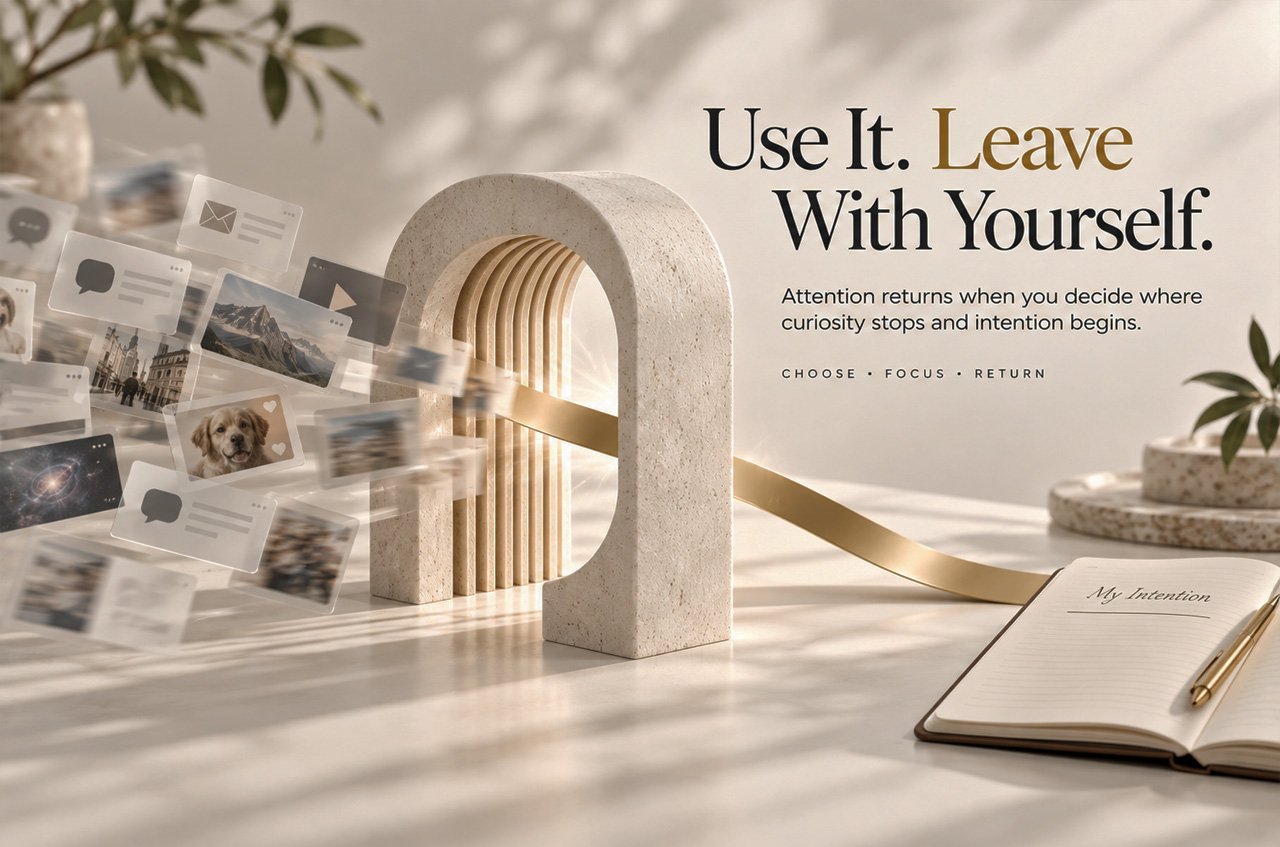
Recovering attention means more than recovering minutes. It means learning again to tolerate the distance between beginning something and receiving a reward, having a conversation without needing a second screen, reading an idea all the way through, and staying with a problem long enough for depth to appear. In other words, deciding consciously where curiosity ends and intention begins.
We live surrounded by infinite content, while our attention remains impressively finite. The real cost of constant scrolling is not only everything we see, but everything we stop observing while we continue looking. The purpose of this book is not to make you abandon your phone; it is to help you enter, do what you intended to do and, to everyone’s surprise, actually come back out.
“Content is infinite. Your attention is not. It helps to remember which one belongs to your life.”